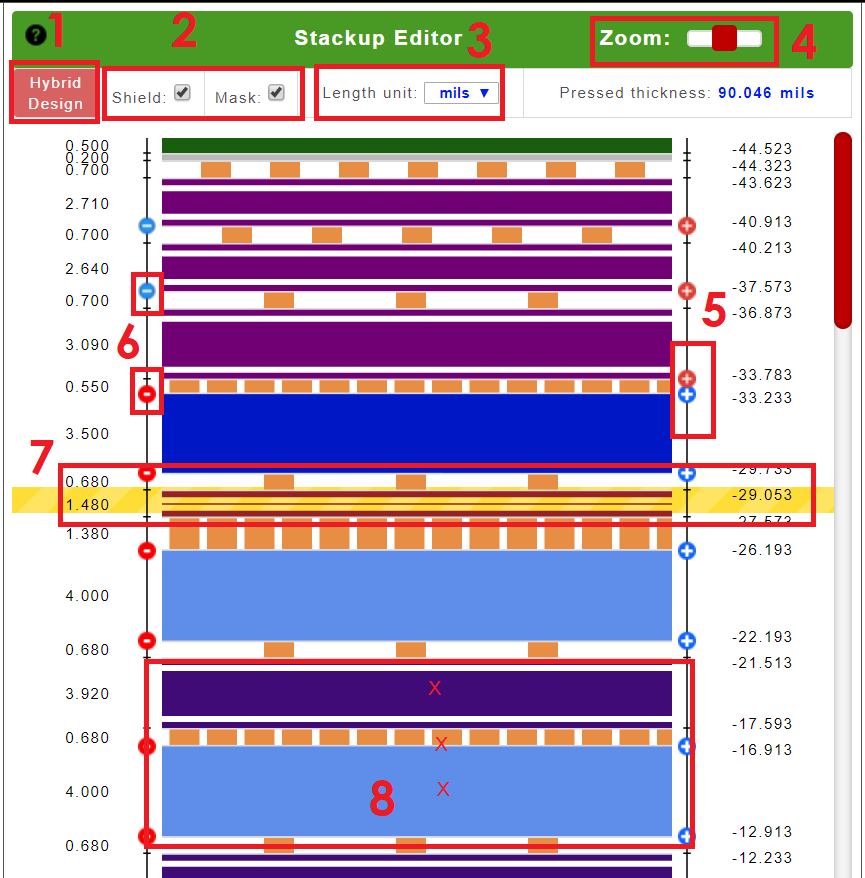
When multiple resins systems are used, a hybrid notification will appear.
Checking the shield or mask check box will add surface finish and soldermask to the outer layers.
Units in mils, mm and µm can be selected.
The Zoom function will compress the stack up to reduce scroll distance.
Clicking the red ‘‘ will add an HDI layer (prepreg and foil). Clicking the blue ‘‘ will add an additional inner layer (core and prepreg).
Clicking the blue ‘‘ will remove the HDI layer (prepreg and foil). Clicking the red ‘‘ will remove the inner layer (core and prepreg).
The yellow warning bar indicates the prepreg is too thin and glass stop may occur.
Left clicking a copper, prepreg or core layer will bring up a window to edit layer properties.
Use ‘Contact Us’ for additional help.
16 July 2021
Related Posts
The Importance of Circuit Board Material for Millimeter-wave Circuits
Growing demands for higher data rates and real-time video require wide bandwidths that are only available at 24 GHz and above. This calls for more than simple network infrastructure additions or modifications as the shorter wavelengths at these frequencies propagate over shorter distances than at microwave frequencies. For expanding 5G…
Drones or unmanned aerial vehicles (UAVs) are typically associated with military users, although a growing number of applications are being found for UAVs in commercial, industrial, and even medical markets. Commercial users await approval from key government agencies, such as the U. S. Federal Aviation Administration, for properly authorized use…
It seems like only yesterday, but Fifth Generation (5G) cellular networks have been making wireless connections for almost four years. Already, some of the major carriers and test-equipment developers are looking ahead to around 2029 or 2030 and the expected start of Sixth Generation (6G) networks. Still, 5G has room…
 ‘ will add an HDI layer (prepreg and foil). Clicking the
  ‘ will add an additional inner layer (core and prepreg).
 ‘ will remove the HDI layer (prepreg and foil). Clicking the
  ‘ will remove the inner layer (core and prepreg).