Isostack Tool Help – Right Panel
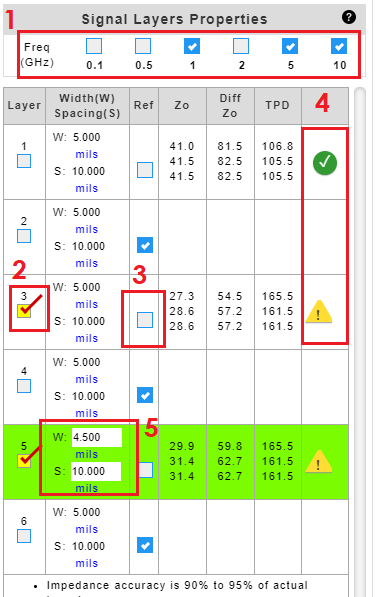
  1. Check to select frequencies to calculate impedance.
  2. Check to highlight the copper layer of interest.
  3. Uncheck reference check box to designate a signal layer. By default, all layers are treated as a reference plane.
  4. 4. A ‘green’ Okcheck mark indicates that the input criteria meet the constraints for the equations used in IsoStack. A ‘yellow’ Warning warning sign indicates that the input criteria do not meet the constraints for the equations used in IsoStack. Click on the icon to reveal the parameters and criteria.
  5. Click to enter or edit trace properties.
NOTE:
Formulas from IPC-2141A Design Guide for High-Speed Controlled Impedance Circuit Board.

16 July 2021

Related Posts

Circuit Materials Fit Into 5g Microcells AP
Packing mmWave Circuits into 5G Microcells
Fifth Generation (5G) wireless cellular networks promise performance that will meet every mobile user’s need, including reliable voice service, fast data, and steady video links. But such achievements will not come overnight, and they will call for a 5G network infrastructure with more cell sites than ever, capable of transmitting…
Press Release Cropped 190x95[1]
ISOLA APPOINTS TROY RUHRER AS NEW CHIEF FINANCIAL OFFICER
“Troy’s promotion validates the strength of our management team and our commitment to growing our Arizona presence,” said Jeff Waters, President and CEO of Isola. “Troy has done an excellent job as the interim head of our finance organization and has demonstrated the capability, competence and maturity to excel as…
Probing Materials for Millimeter-Wave PCBs
Analog frequencies and digital data rates are increasing steadily in electronic circuits and systems, requiring careful choices of circuit materials for printed circuit boards (PCBs). Cellular communications technologies grew by means of RF and microwave signal frequencies, but Fifth Generation (5G) cellular wireless networks are making use of available bandwidth…